Kidogo
Early childhood education really matters. So does quality daycare. Most kids in urban Kenya get neither.
The Idea
Quality Childcare Microbusinesses
Fellow

Sabrina Habib
Mulago Lead
s


.jpeg)
Total Investment
750000
Grants
0
Equity/SAFE
0
Debt/Convertible Debt
Funded Since
2022
Geography
Sector
Structure
The Mission
Thriving kids.
How It Works
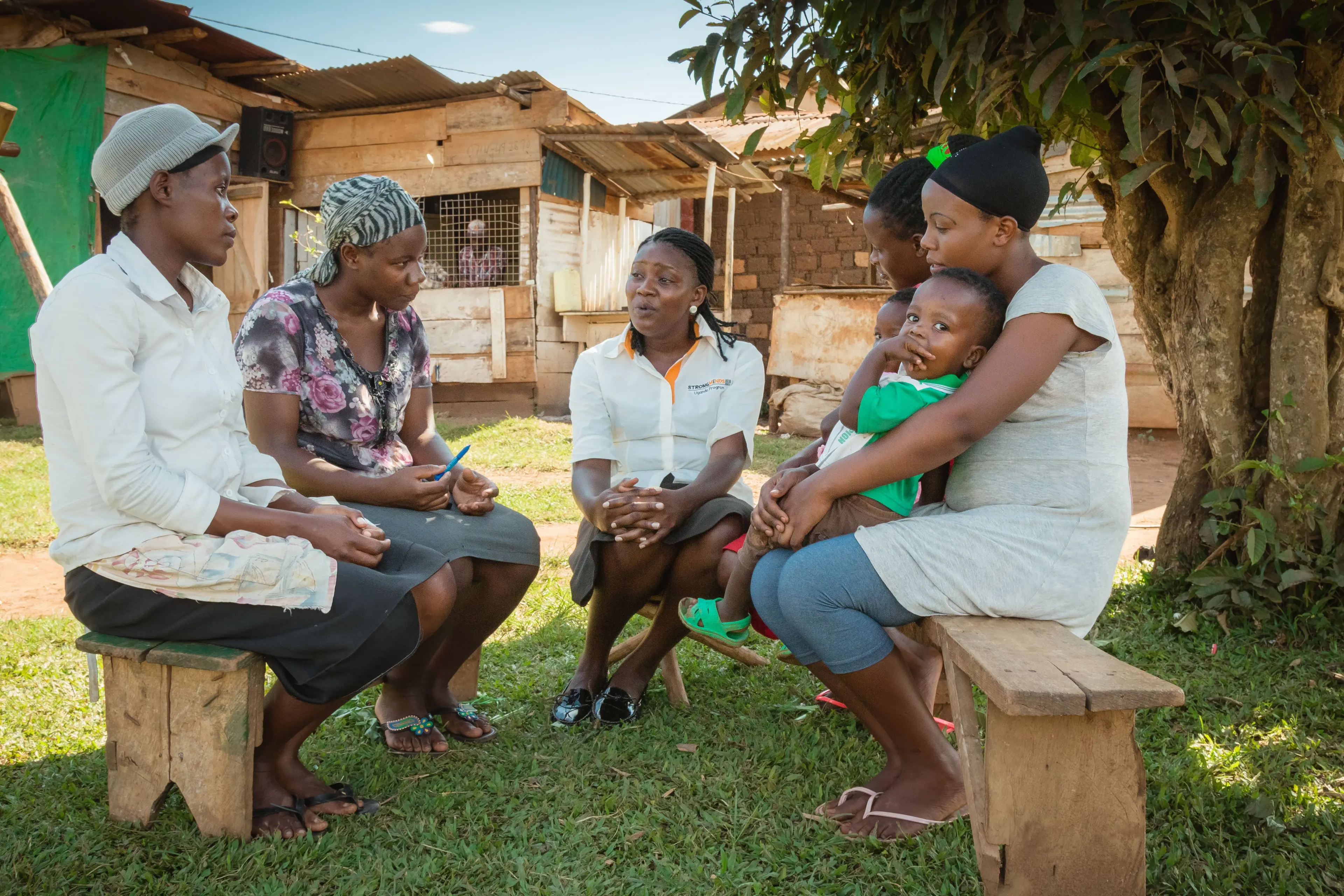
Kidogo taps an existing workforce of informal providers and brings them under their brand. They boost provider care (safer spaces, proven play-based curriculum, better nutrition) and train them on business basics.
The Dream
A high-quality daycare industry that is regulated and subsidized by governments.
Why We're In
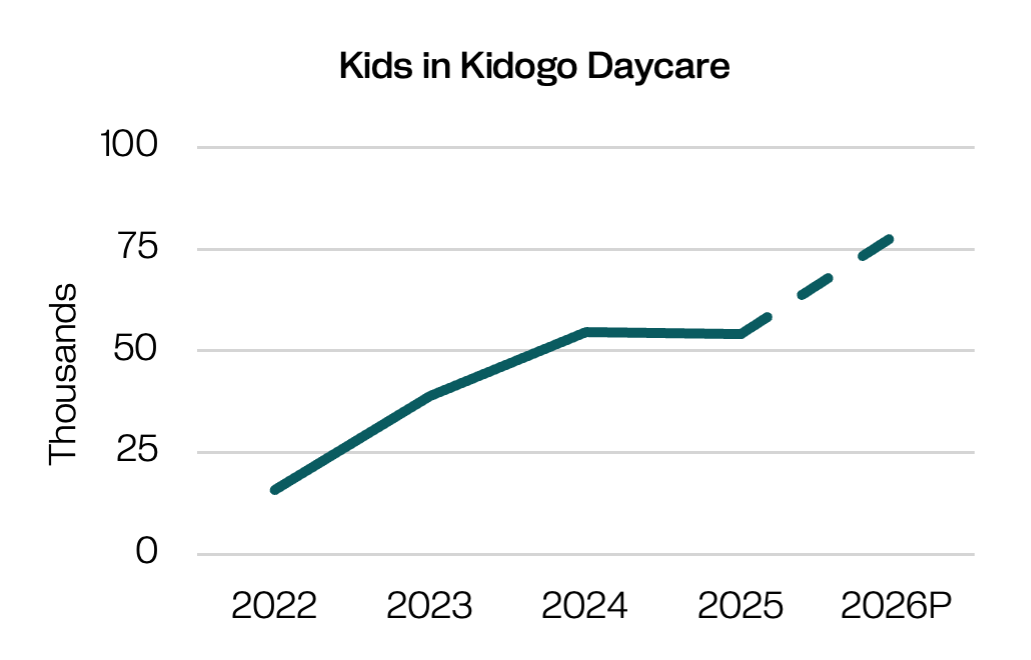
Kenya is on the cusp of a more formal childcare industry. Kidogo is shaping the regulatory standards—from safety to quality—and government resources to make it work for families. Kidogo serves ~54K kids, so they know what it takes to help home-based providers deliver quality care and run a viable business. They’ve also learned that quality costs more than poor parents can pay so scale will require government subsidies. We’re betting that Kidogo’s experience and brand puts them in a unique position to deliver on an ambitious regulatory and financing framework in partnership with government.
The Model
A solution that works and can scale.
Trained providers
Childcare providers are trained to 1) maintain safe spaces, 2) provide nurturing care, and 3) develop solid businesses (e.g., tracking enrollment, attendance, and finances).
Safe spaces
Homes and rented spaces are upgraded to meet safety and sanitary standards (e.g., lighting, ventilation, handwashing, toileting facilities, clean drinking water) and a standard child/caregiver ratio.
Nurturing care
Best practices in nurturing care inform a curriculum on responsive caregiving (e.g., attentive, back-and-forth interactions, age-appropriate language), positive discipline, and a play-based learning environment with sufficient toys, books, and daily activities.
Nutrition
One nutritious meal, two snacks per day, and targeted fortified foods (e.g., porridge) at least twice/week. Intervention in severe cases of malnutrition through growth monitoring and referrals.
Potential for Impact at Scale
Mulago uses four criteria to gauge potential for exponential impact. The model must be:
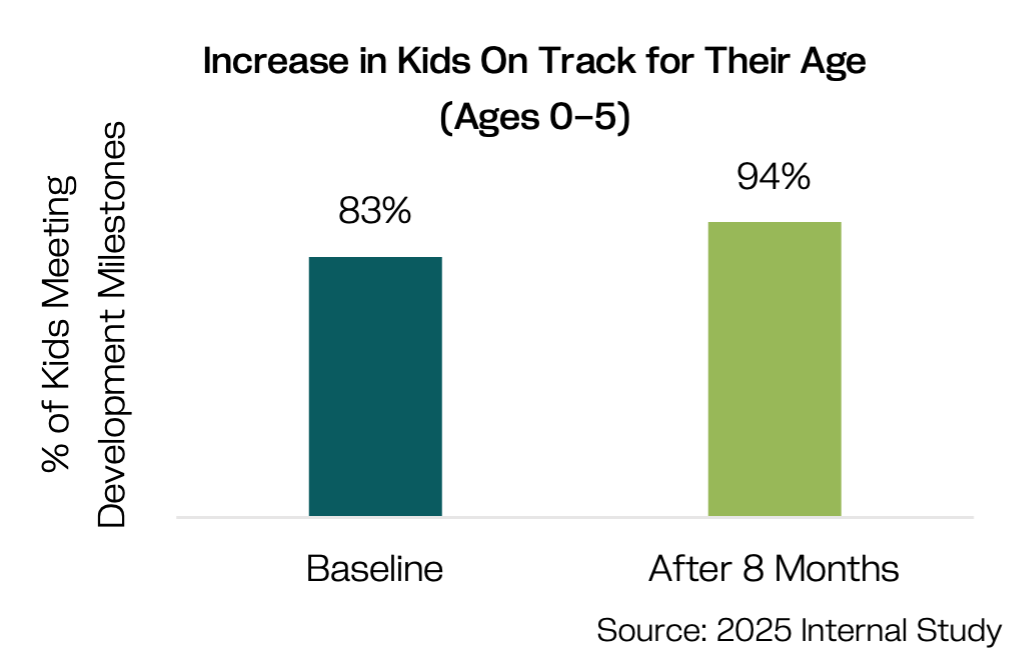
This is about impact and evidence. Kidogo is in the middle of an RCT that will offer rigorous evidence of if their quality standards are linked to child outcomes. To date, they have updated their metrics for measuring childcare-center quality and have program data that indicates that after a year in a Kidogo-accredited center, 94% of children are hitting development milestones (up from a program baseline of 83% and compared to a national average for 4-5 years olds of 74%). These are positive signals but the RCT results, expected at the end of 2026, are needed to truly understand the impact of the model.
This is about scope. Half the kids in Kenya lack access to childcare because there are not enough high-quality, affordable options. A major constraint is lack of a formal childcare sector, but Kidogo is already working with government to change that, co-creating the standards, licensing process, and curriculum to establish a formal sector. They also know a major constraint is that many parents cannot pay and are pushing for a government subsidy. South Africa has a childcare subsidy now and is often seen as a signal of what’s possible in Kenya. But it’s also a question of if cultural norms around the value of childcare can shift.
This is about whether businesses can deliver the model. Kidogo is still very involved in delivering the model. 92% of businesses receiving high-touch support maintain Kidogo’s quality levels, though low-touch businesses averaged 80%. This signals that there is a ways to go before the model is simple enough for the doers (childcare businesses) to do. But Kidogo has tested ways to simplify, including reducing training time for Mamapreneurs while still reaching the quality threshold, and will continue to seek efficiencies during an implementation in partnership with Nairobi County, where they will work to add 1,000 new centers in 2026.
This is about what the model costs if delivered by businesses and whether customers (parents) are willing and able to pay. It costs Kidogo $74/child/year to support the Mamapreneurs, including the upfront ~$433/center upgrade costs, which is funded through philanthropy. The dream is for these businesses to operate profitably, however Mamapreneurs tend to operate at a loss because parents are not able (or sometimes willing) to pay. This market failure means that a government subsidy, estimated to be at minimum ~$26 , is required to get all kids who need it into nurturing care. Kidogo has started discussions around the subsidy with government but if and when it will be unlocked remains to be seen.
.png)
Kidogo is in early Growth stage, tuning the model and expanding within active and new counties.
Our Take
We think Kidogo has potential for scale in Kenya and to build a formal childcare sector, if they can land on a disciplined, scalable model. In this past year, they made their quality-check tool more rigorous and recorded directionally positive outcomes for kids. These are good signals, and we look forward to more rigor from the RCT. Kidogo’s made meaningful progress in informing standards, ECD budgets, and government buy-in, mostly notably in Nairobi and Mombasa counties. However, the model is still too expensive at the per child level, and the market failure makes it hard for Mamapreneurs to be profitable. We do know that retention is over 90%, a signal that it’s worth it to businesses to stay open. A simpler and cheaper model remains the priority.
Are you a serious funder and want to learn more?
This is just a snapshot of what we know about the organization. If you're an investor or funder that might send some serious dough their way, we're always delighted to share more. Reach out and we'll connect you with the right person on our team.
*this is not monitored for funding requests.
.jpeg)


Ujamaa Community Resource Team (UCRT)
Lasting Land Rights for Pastoralists.