Food 4 Education
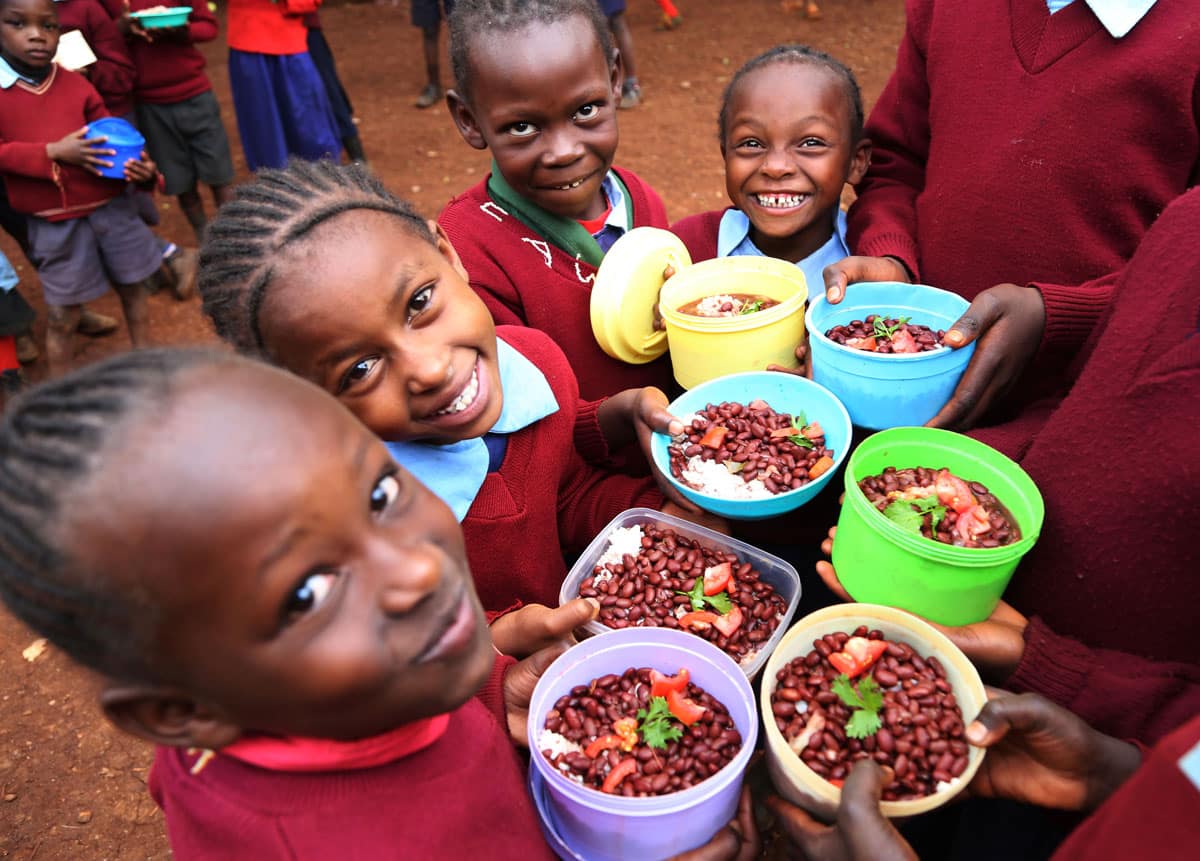
Kids come to school hungry in much of Africa. Hungry kids don’t learn.
The Idea
Outsourced School Lunches
Fellow

Wawira Njiru
Mulago Lead
Total Investment
2350000
Grants
0
Equity/SAFE
0
Debt/Convertible Debt
Funded Since
2018
Geography
Sector
Structure
The Mission
Well-fed school kids
How It Works
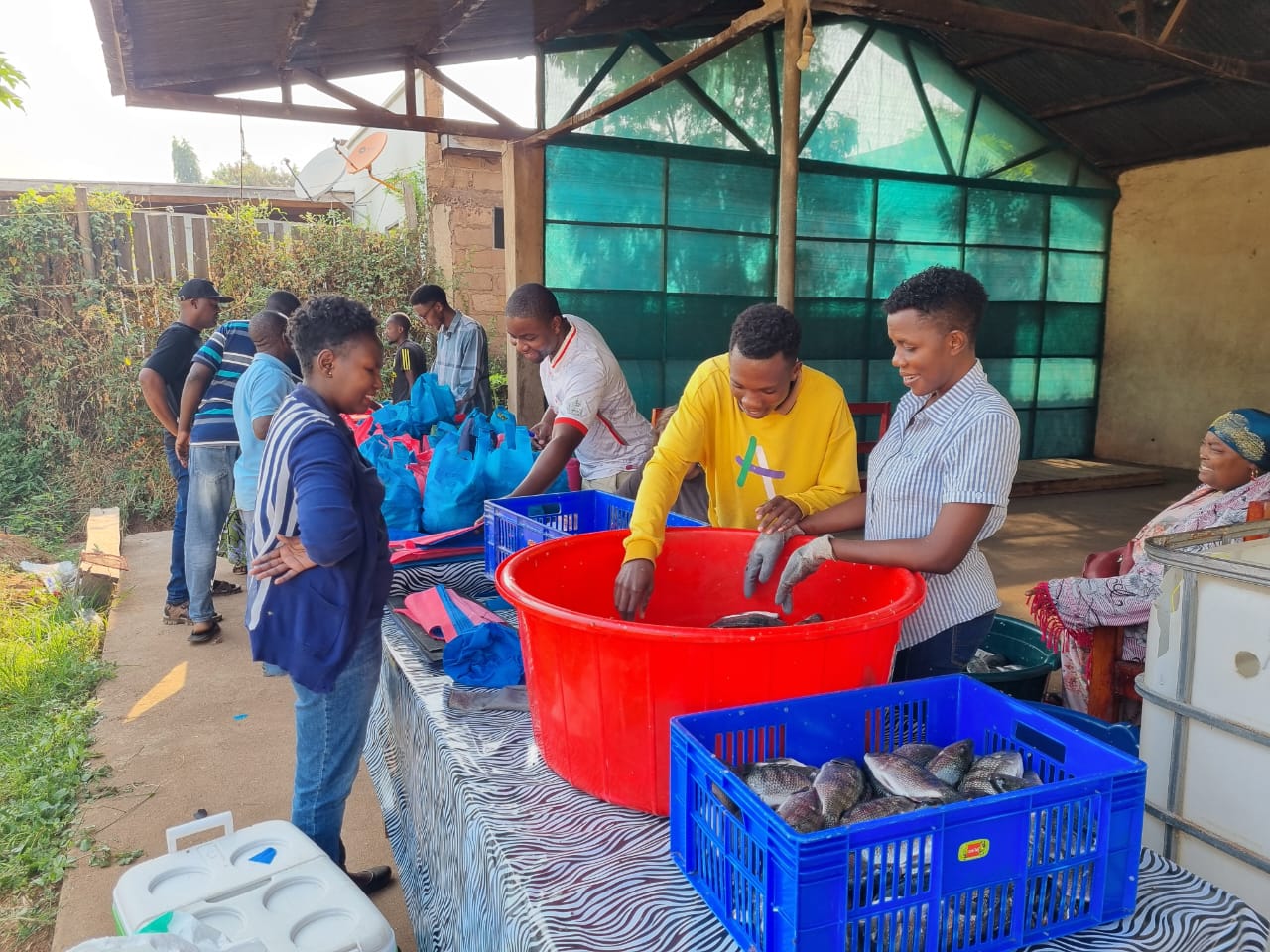
Food4Education (F4E) has devised an efficient “hub-and-spoke” kitchen model to source, prepare, and distribute healthy school meals in bulk. Kids pay onsite for their lunches using a prepaid “Tap2Eat” wrist device. Government subsidies get the price down to what parents can afford.
The Dream
Food businesses—small, medium, and large—prepare and deliver school lunches to all kids, supported by government subsidy.
Why We're In
School feeding is one of the most effective education interventions, but cost has been a hindrance. F4E’s focus on cost, logistics, and securing a government subsidy has made it affordable to families—$0.29 per meal per child. They are building the blueprint for school feeding in Africa, reaching 600K kids daily. The model works in urban settings. Now they’re figuring out the rural model, where 70% of Kenya’s kids are. They’re exploring two pathways to scale. Nationally, they are testing ways to teach others their model, and across Africa, they will advise governments on how to replicate this model in their countries.
Delivery
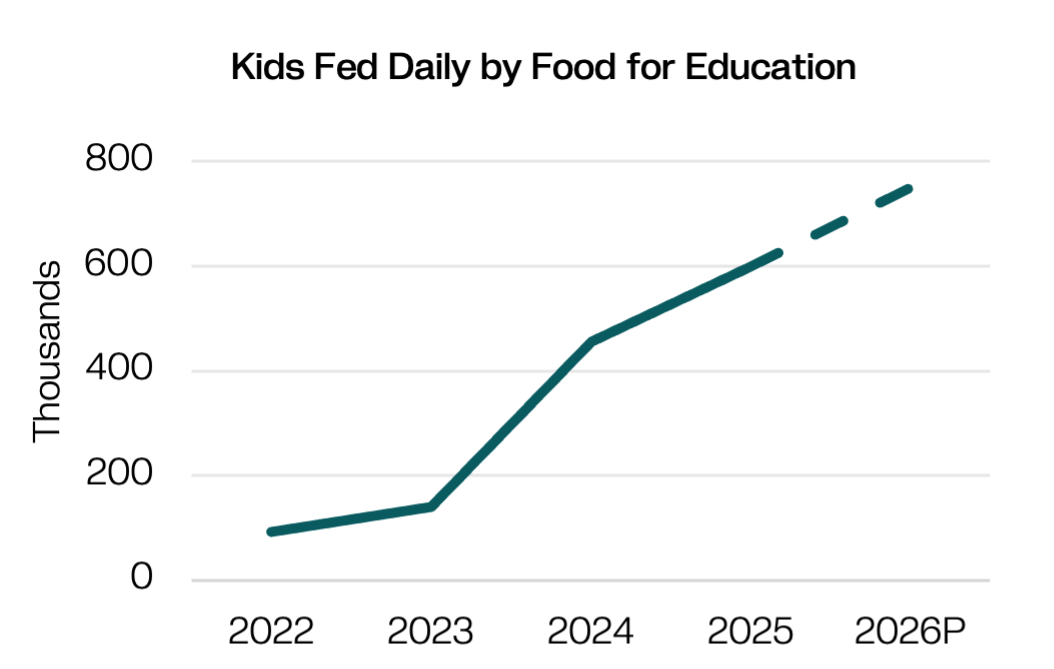
Food4Education has significantly grown the number of kids fed daily and is on track to hit their target of 1 million kids fed by 2027.
The Model
A solution that works and can scale.
Meals
Design nutritious recipes and portions
Sourcing
Line up suppliers to ensure quality inputs all year
Prep & Delivery
Construct large kitchens to prepare meals in bulk and distribute to schools daily
Enrollment
Get schools and parents enrolled and bought into the system
Payments
Collect cashless payments, using Tap2Eat technology, to quickly serve large numbers of kids
Potential for Impact at Scale
Mulago uses four criteria to gauge potential for exponential impact. The model must be:
This is about impact and evidence. The impact of school feeding has been well established in many geographies . We are focused on “kids fed” as the most relevant measure of impact, and F4E has proven that their model can feed many children a high-quality meal in Kenyan urban settings. Right now, they are feeding 600K kids across 13 counties.
This is about scope. The model is needed anywhere that students are not eating healthy, affordable lunch daily. In Kenya, there are 10.1 million students in public primary schools and ECD centers. The model works where there is high enrollment in public schools (in Kenya, 84% of children are enrolled in public primary schools), government is willing and able to provide a subsidy, and distribution logistics are feasible. Broadly speaking, F4E has proven that Kenya has the right conditions for the solution to work there, but it’s unclear whether other countries could do this or if these conditions make Kenya a special context.
This is about whether food businesses can deliver the model. F4E’s centralized and semi-centralized kitchen models in urban and peri-urban areas work when they deliver it. They’ve built sufficient central kitchens to service the entire population in Nairobi county. Now, they are testing various adaptations of the model to better suit rural contexts. They are in the process of documenting their own processes and setting up a Center of Excellence to train other food businesses (like existing school feeding programs, community-based entrepreneurs, and small catering companies) to replicate their model. However, they have not yet replicated the model via others yet.
This is about what the model costs if delivered by businesses and whether parents are willing and able to pay. While costs vary based on the rural/urban context, type of meal, and number of staff per kitchen, on average, in urban areas, Food4Education charges 30 ksh (~$0.29) per lunch. Right now, in Nairobi, parents are paying ~5 ksh and the county government is providing a ~25 ksh subsidy. In rural areas, on average, they serve porridge for ~$0.14. They plan to test a cost structure where businesses who replicate this model could make a small profit margin.
.png)
Food4Education is in late Growth stage, proving out the rural model and testing how to recruit and train other doers.
Our Take
Food4Education’s urban and peri-urban model works remarkably well—tight logistics, strong operations, and relentless cost discipline have enabled scale, with parents paying and county governments subsidizing. They’re now applying the same rigor to figuring out how to serve rural areas: testing meals, logistics, and delivery models to reach dispersed populations efficiently. The big open question is replication via others. It’s unclear whether other food businesses can generate attractive profit margins, especially without the scale advantages that underpin Food4Education’s urban model. We share the same questions for the rural model.
Are you a serious funder and want to learn more?
This is just a snapshot of what we know about the organization. If you're an investor or funder that might send some serious dough their way, we're always delighted to share more. Reach out and we'll connect you with the right person on our team.
*this is not monitored for funding requests.
.jpeg)
.jpeg)